It is always a pleasure to run across vintage advertising featuring photographs from this archive. Marian Pearce, an amateur from Waukegan, IL, was the grand prize winner in 1908 for this original platinum photograph in the Eastman Kodak Company’s annual advertising contest. Her winning entry, featuring a young girl snapping a photo of her (presumed) younger sister with a Brownie camera appeared in the Ladies Home Journal the following year.
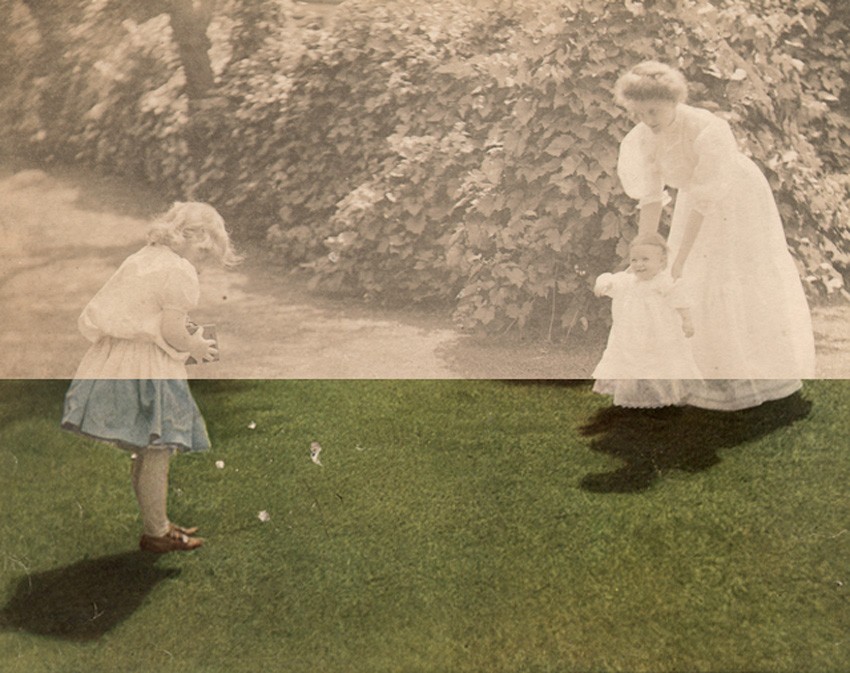
Composite illustration: top: Mrs. W.W. Pearce: black & white detail: from original platinum print: “1908 Kodak Photographic Advertising Contest First Prize Winner, Amateur Class”: 15.3 x 19.3 cm | bottom: detail: 3-color halftone: from “Let the Children Kodak”, by the Eastman Kodak Company reproduced in June, 1909 issue of the American magazine “Ladies Home Journal”
What was unexpected was seeing the photograph in the ad published in color. Eastman Kodak advertising manager L.B. Jones oversaw this campaign, with the theme of “Let the Children Kodak.” The three-color halftone process used to reproduce the photo in the June, 1909 issue of the magazine may have been the result of a hand-colored version of the Pearce photograph.
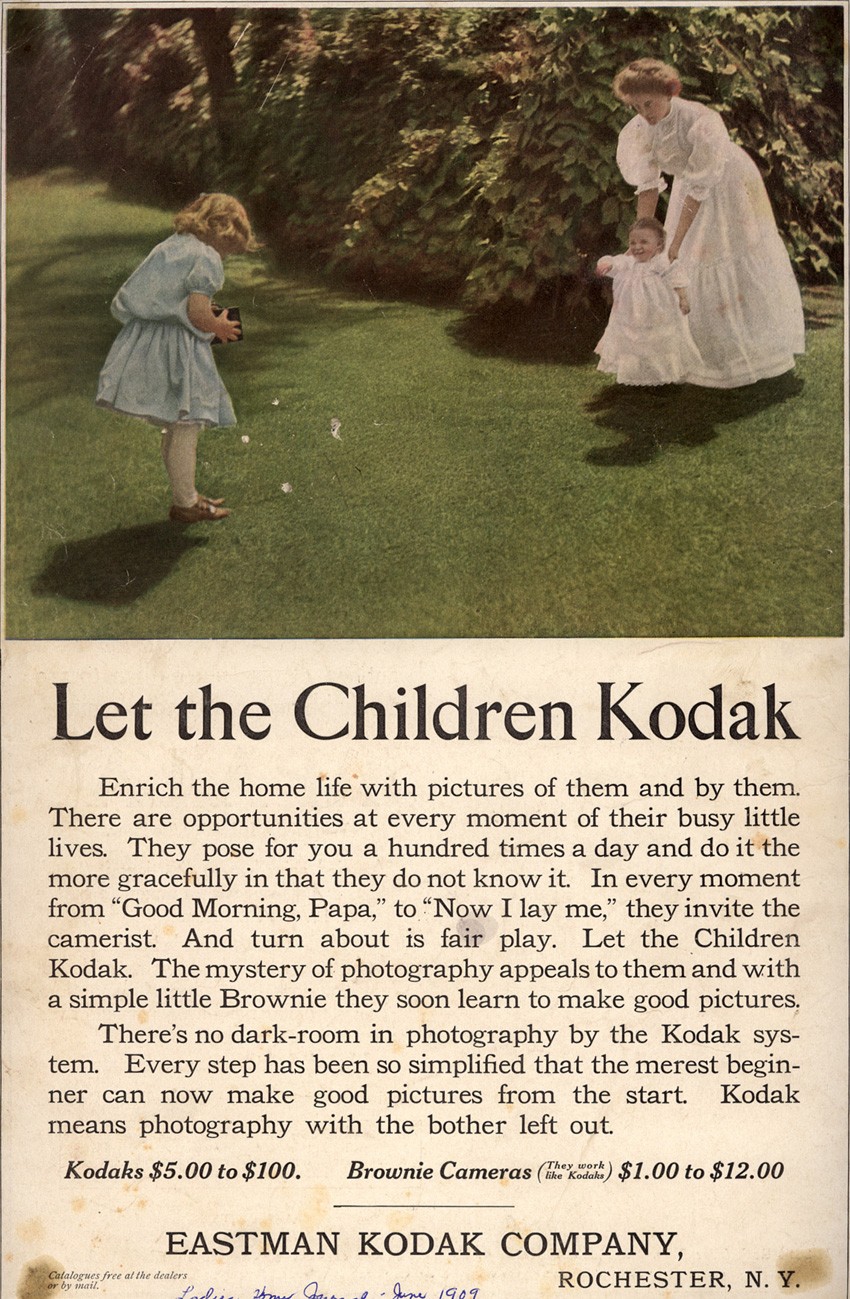
“Let the Children Kodak” : vintage advertisement in June, 1909 issue of “Ladies Home Journal”: from: online resource: Emergence of Advertising in America: 1850-1920: Duke University David M. Rubenstein Rare Book & Manuscript Library
Sadly, Mrs. Pearce is not given credit for the photo in the ad, which is of course still common today, although her grand prize of $300.00 she earned in the amateur category of the 1908 contest was a king’s ransom for the time.
Since PhotoSeed launched a month ago, I have been putting together material on a run of the important German photographic journal known as Photographische Mitteilungen. (Photographic Reports) Several hundred photographs, almost all of them hand-pulled photogravures, are now searchable in our archive database. As a working photographer myself, it is an honor to be able to give new light to this material and introduce fresh eyes to it over a century later.
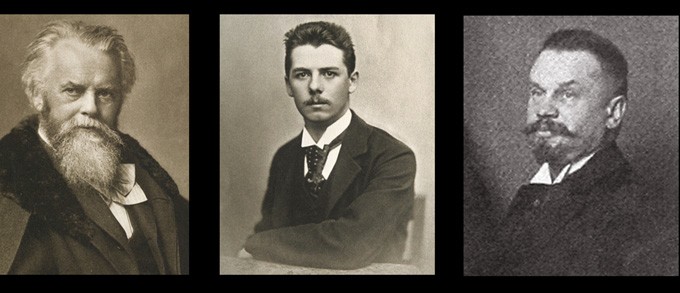
From left to right: Photographische Mitteilungen founder and editor H.W. Vogel: 1864-1898; his son Dr. Ernst Vogel, who edited the journal from at least 1893-1901; and Paul Hanneke-sole editor from 1901-1911.
The challenge for me has been trying to get things right the first time. The language barrier in assessing this material has often been difficult in some cases to overcome. But fear not. If I’m not comfortable about something regarding a translation, I will probably not include it unless I spell it out verbatim on the site-which I have done in a few cases already. I wish I could say I spoke five languages but since four years of high school French is my reality, Google as well as other online translation software has taken up the slack in this department. I have been translating titles of the work where appropriate (found in the misc. tags area) in order to give our English-speaking audience an idea what the photographer’s intent was as well. “Unidentified” seems to be my new favorite word on some days but consistency will always be my mantra while adding material to the site.
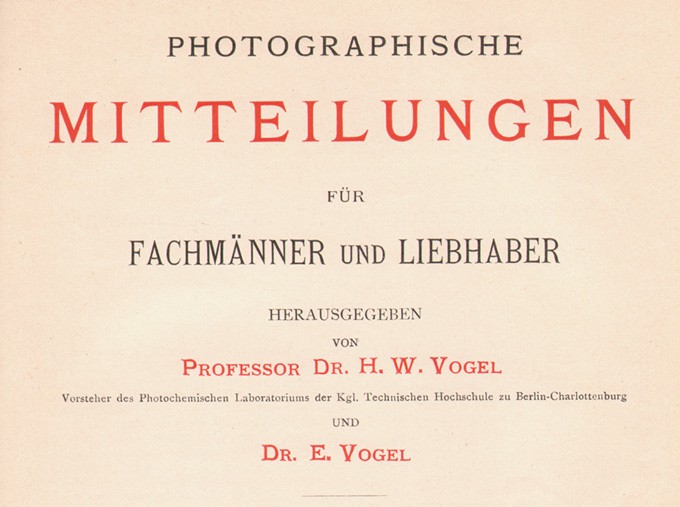
This detail shows the title page for the 30th year of Photographische Mitteilungen covering 1893-1894.
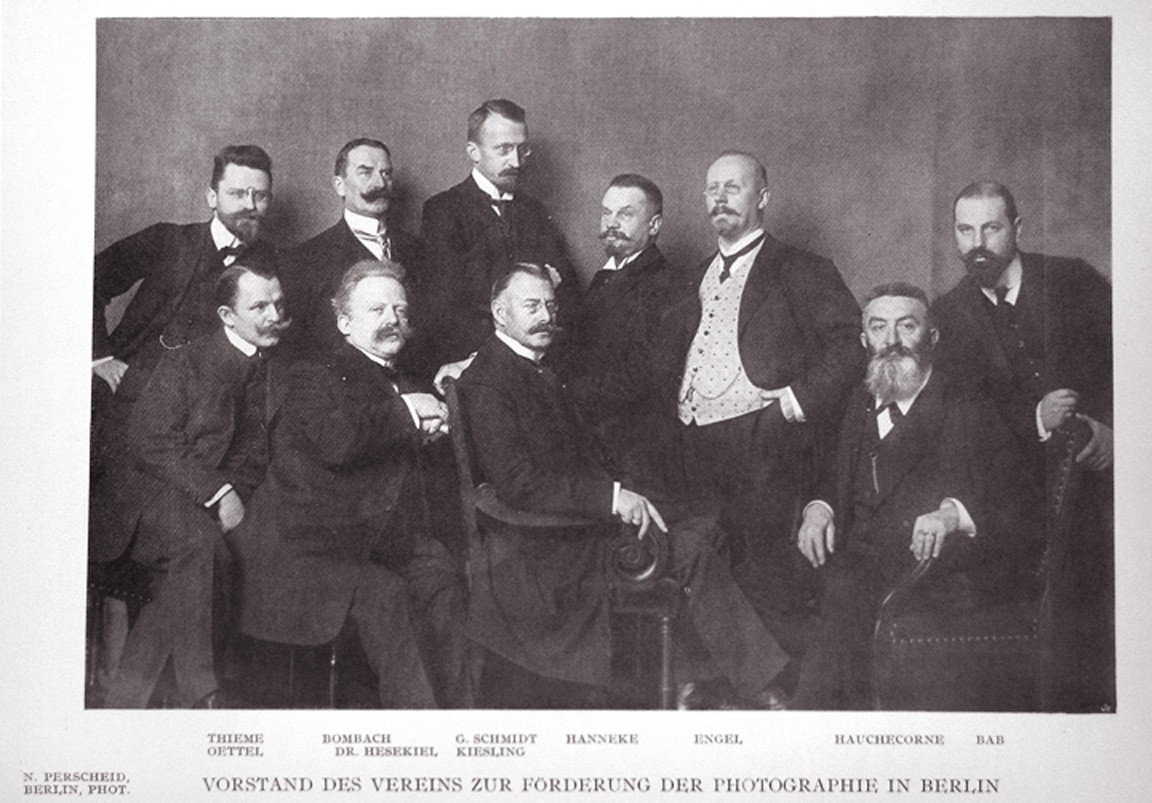
This photograph taken by Berlin photographer Nicola Percheid from the March, 1909 issue of Photographische Mitteilungen shows board members of the Association for the Promotion of Photography in Berlin. (Vorstand des Vereins zur Förderung der Photographie in Berlin) This is the same organization founded by H.W. Vogel in 1863. In the early years of the publication, the name was incorporated into the title page since the journal was actually its mouthpiece. (example- Photographische Mittheilungen: Zeitschrift des Vereins zur Förderung der Photographie) Over the years, the journal lost the “h” in Mittheilungen as well. Seen in this photograph at center is journal editor Paul Hanneke and to his right, journal publisher Gustav Schmidt.
In researching the history of the journal, I discovered early examples of color plates reproduced from 1893. Twenty years earlier, journal founder and photochemist H.W. Vogel had first figured out how color sensitizing agents could be added to photographic plates in order for objects to delineate themselves into their proper shades of gray.
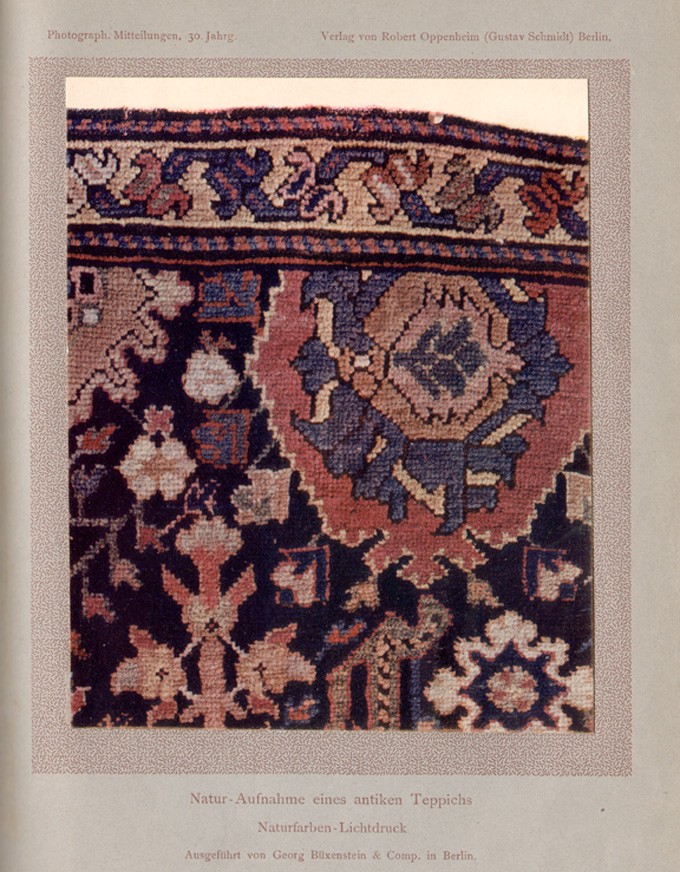
This very early natural-color collotype photograph showing a swatch of an antique rug was done by the atelier Georg Büxenstein in Berlin and reproduced as a full-page plate in the April 15 (heft 2) 1893 issue of Photographische Mitteilungen. Dimensions- image- 15.3 x 12.2 cm -support- 24.4 x 16.9 cm (trimmed)
Later, his son Ernst Vogel- (who had joined his father as co-editor at an undetermined date but at least since 1893) took up the challenge of printing three-color photographs in halftone as well as collotype. He first teamed up with William Kurtz in New York in 1892 (who was a good friend of his father’s) and a year later with Berlin engraver Georg Büxenstein.
The three-color halftone below showing a still life of fruit reproduced in the January, 1893 issue of the journal is believed to be one of the very first three-color halftones ever done on a large scale. In Berlin, Ernst Vogel’s subsequent business relationship with Büxenstein bore additional fruit in the form of this firm’s exquisite gravure plates now available for your examination on our site.
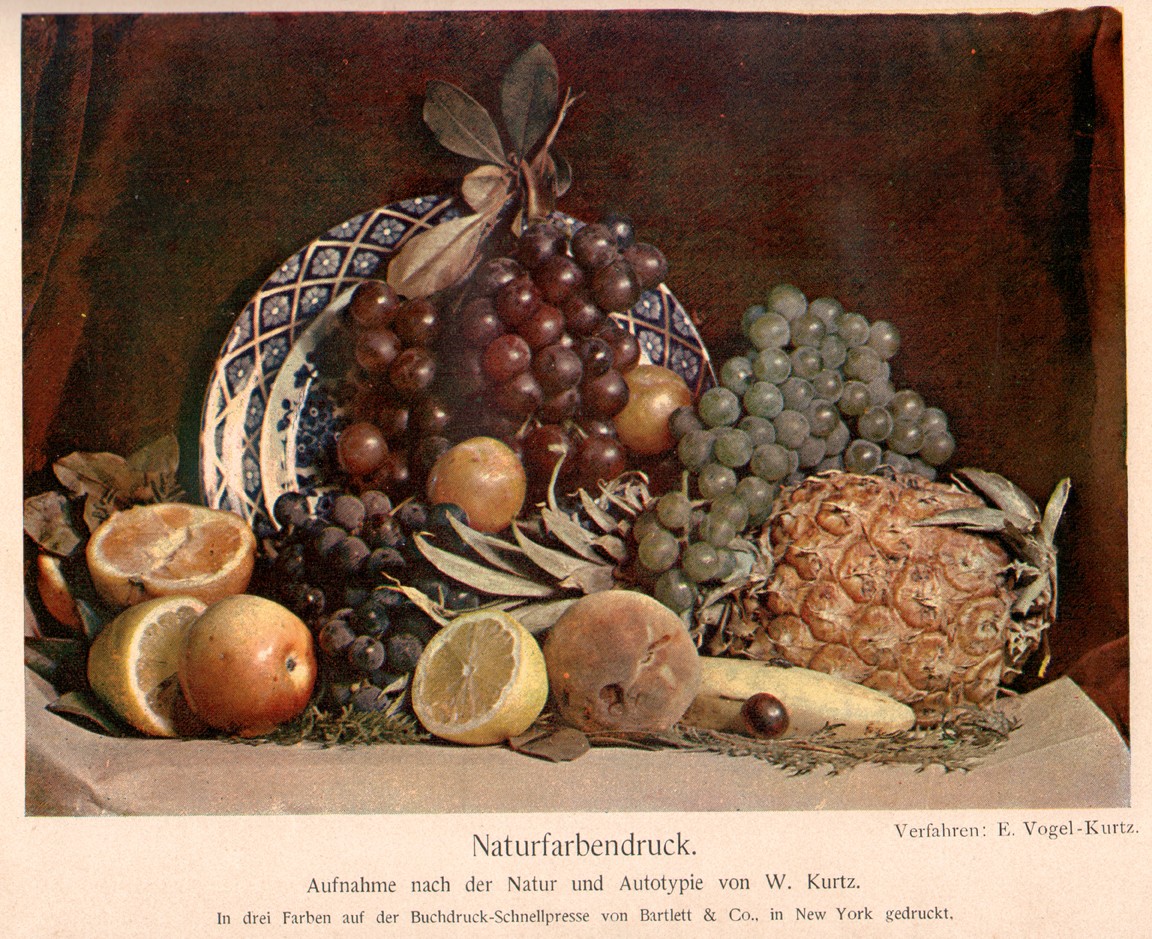
The New York engravers Bartlett & Co. under the direction of William Kurtz and Ernst Vogel printed this very early three-color halftone image. Dimensions: image: 13.3 x 18.3 cm : support: 16.7 x 24.5 cm coated stock paper (trimmed)